
Mortgage Rates Just Hit 7.4%: What’s Driving Them and What It Means for You
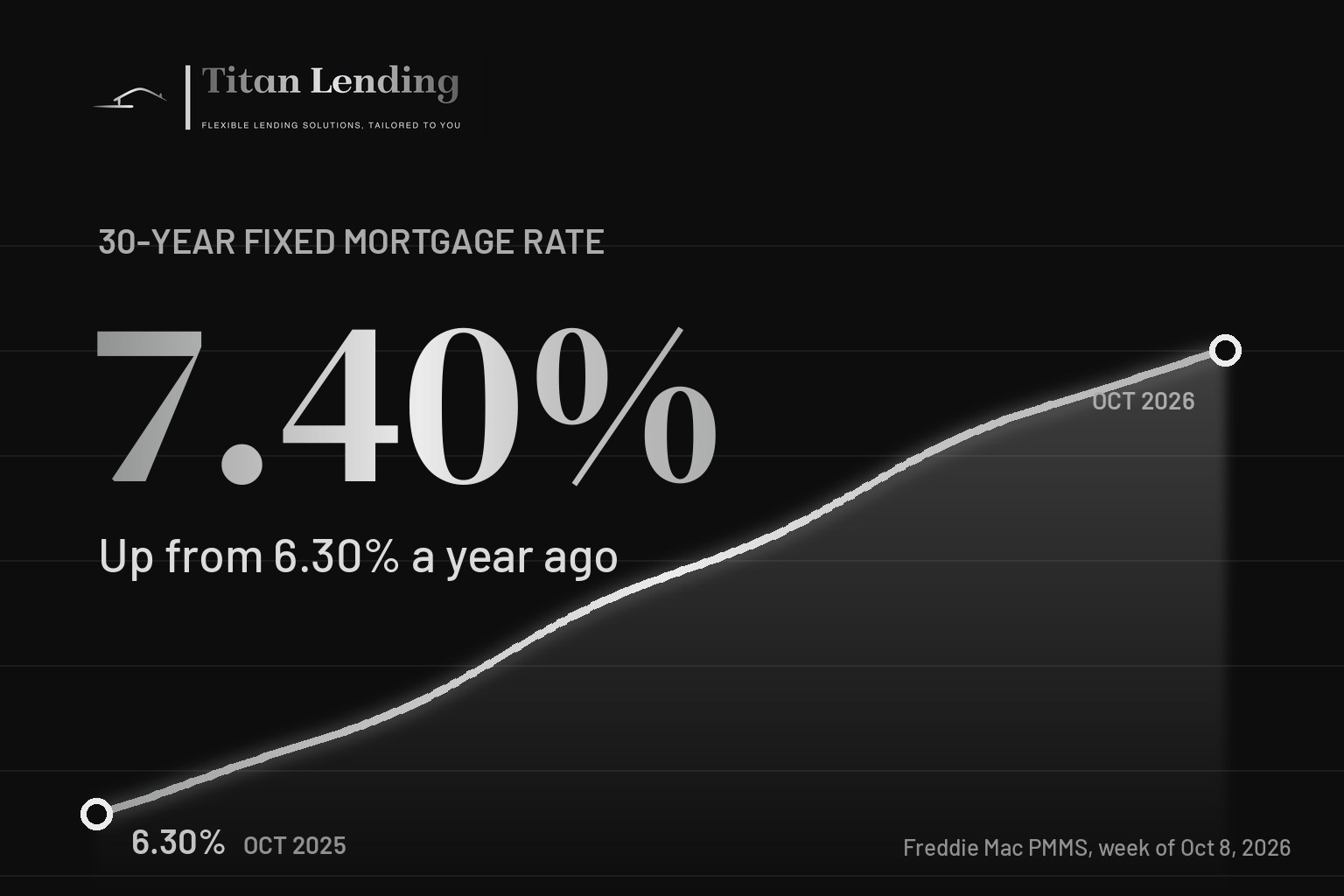
If you have checked mortgage rates recently, you have probably noticed they are moving in the wrong direction. The average 30-year fixed rate climbed to 7.40% for the week of October 8, 2026, according to Freddie Mac. That is the seventh weekly increase in a row, the highest level since late 2023, and more than a full percentage point above where rates stood a year ago (6.30%). The average 15-year fixed rate rose to 6.73%.
Here is a plain-English look at what is behind the jump, what it means for home buyers, homeowners and business borrowers, and how to plan around it.
What is pushing rates higher
Mortgage rates are not set directly by the Federal Reserve. They tend to follow the 10-year U.S. Treasury yield, which reflects what investors demand to lend money for the long haul. Several forces have driven that yield sharply higher this fall:
- A bond market selloff. The 10-year Treasury yield rose from about 4.75% at the end of August to roughly 5.3% in early October, briefly touching its highest level since 2002. Long-term government bond yields rose in several other major economies at the same time.
- Stubborn inflation. Consumer prices were up 3.4% from a year earlier in August, with higher oil and gasoline prices adding pressure. When investors expect inflation to stay elevated, they demand higher yields.
- A Fed rate increase. On September 16, the Federal Reserve raised its benchmark rate by a quarter point, to a range of 3.75% to 4.00%, saying inflation remains elevated. Markets are now weighing the possibility of another increase before year-end.
- Heavy borrowing. Large government deficits and a wave of corporate bond issuance mean more bonds competing for investors, which tends to push yields up.
What it means for home buyers
Higher rates make the same loan cost more each month. On a $400,000, 30-year fixed loan, principal and interest at 7.40% comes to about $2,770 a month, compared with about $2,476 at 6.30%. That is roughly $294 more per month, or about $3,500 a year.
That does not mean buyers are out of options. Higher rates also tend to cool competition, which can give buyers more room to negotiate on price, repairs and closing costs. A few strategies worth discussing with a loan advisor:
- Seller-paid rate buydowns. Instead of a price cut, a seller credit can be used to lower your rate, either temporarily or for the life of the loan.
- Adjustable-rate mortgages. An ARM with a fixed period of five, seven or ten years can start with a lower rate than a 30-year fixed. Make sure you understand how and when the rate can adjust.
- Government-backed loans. FHA and VA loans are often priced differently from conventional loans and may be worth comparing if you qualify.
- Shopping around. Rates and fees vary between lenders. Freddie Mac itself notes that getting multiple quotes can save borrowers thousands.
Some buyers plan to refinance if rates fall later. That can work, but it is never guaranteed, and refinancing comes with its own costs. Buy a home whose payment you are comfortable with at today’s rate.
What it means for current homeowners
If you already have a mortgage below today’s rates, a traditional refinance probably does not make sense right now. If you need to tap your home equity for renovations, debt consolidation or another goal, a home equity loan or line of credit may let you borrow without giving up the low rate on your first mortgage. The right choice depends on how much you need, how quickly you plan to repay it and your overall financial picture.
What it means for commercial and business borrowers
Many commercial real estate and business loans are priced off short-term benchmarks such as the prime rate or SOFR, which move closely with the Federal Reserve. The prime rate typically sits three percentage points above the top of the Fed’s target range, so the September increase raised costs for many variable-rate borrowers right away.
If you have a variable-rate loan or line of credit, or plan to finance a property or business purchase in the coming months, it may be worth reviewing whether a fixed rate, a longer amortization or a different loan structure would give you more predictable payments.
Where could rates go from here?
No one can predict rates with certainty. In an October Reuters poll, bond strategists expected the 10-year Treasury yield to ease slightly over the next year, but most said the risks lean toward yields staying higher than forecast. The Federal Reserve’s next two meetings are scheduled for late October and early December, and new inflation and jobs reports will keep markets moving in the meantime.
Rather than trying to time the market, focus on what you can control: your credit, your down payment, your budget and choosing a loan structure that fits your plans.
Talk it through with Titan
At Titan Lending Solutions, we work with residential, commercial and business borrowers and have access to a wide range of wholesale loan options. If you are weighing a purchase, a refinance or a business loan, we will walk you through your options and what today’s market means for you. Call us at 240-931-2010 or apply online.
Sources
- Freddie Mac Primary Mortgage Market Survey, week of October 8, 2026
- Federal Reserve FOMC statement, September 16, 2026
- U.S. Bureau of Labor Statistics, Consumer Price Index for August 2026 (released September 11, 2026)
- Reuters poll of bond strategists, October 2026
Rates cited are national averages published by Freddie Mac and are for informational purposes only. They are not an offer or a commitment to lend. Payment examples include principal and interest only and exclude taxes, insurance and mortgage insurance. Your rate and terms will depend on your credit, property, loan amount and other factors. All loans are subject to credit and property approval. Saturn Commercial Finance Inc., dba Titan Lending Solutions, NMLS ID #2480814 (www.nmlsconsumeraccess.org). Equal Housing Opportunity.

